Logistics and Transport Firms in Australia: Infrastructure Backbone and Practical Efficiency
Freight movement in Australia is defined by distance and diversity. A shipment may travel from an inland farm to a regional packing shed, then to a port for export—or move from an Asian supplier to an Australian warehouse and finally to a suburban doorstep. Because of this complexity, logistics and transportation companies build competitive advantage through infrastructure positioning (near ports, airports, and major roads) and operational solutions that reduce delays, damage, and cost.
The physical backbone: ports, roads, rail, and air
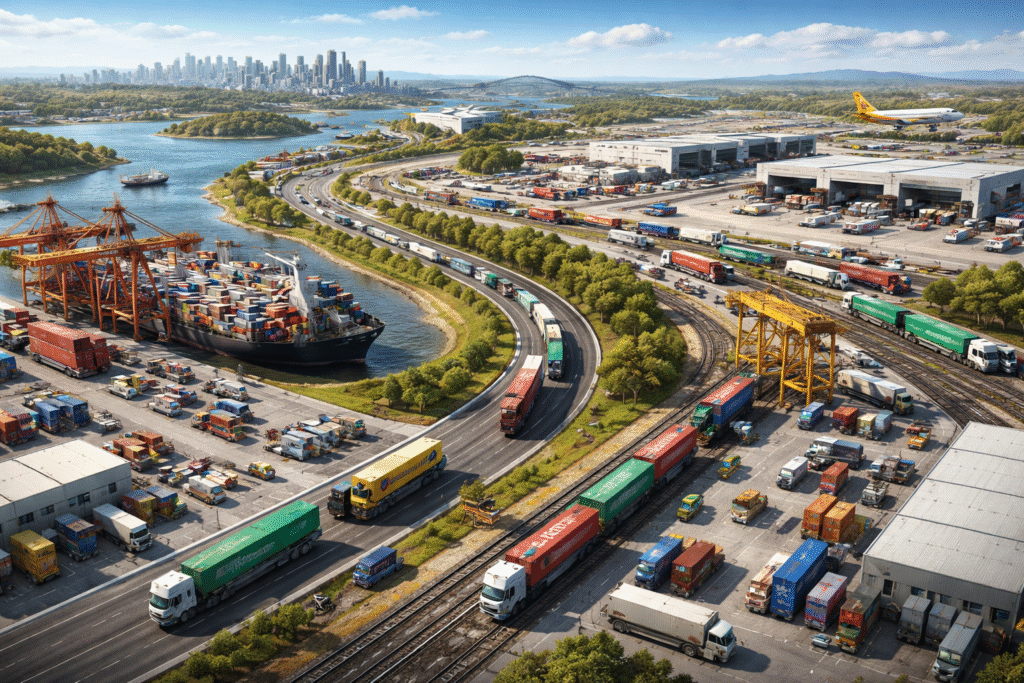
Australia’s containerised imports and exports concentrate around large gateways such as Melbourne, Sydney’s Port Botany, Brisbane, and Fremantle. These ports are surrounded by logistics estates containing container parks, quarantine-capable facilities, and cross-dock operations that speed up transfer from vessel to distribution networks.
Domestic distribution depends heavily on road freight: highways and freight corridors connect capital cities, while smaller arterial routes serve mining regions and agricultural areas. Rail is pivotal for high-volume freight over long distances and for bulk commodities. Intermodal terminals—where containers shift between train and truck—allow providers to combine the cost efficiency of rail with the flexibility of road. Air freight sits at the premium end of the market and is crucial for urgent items, high-value goods, and perishables when speed outweighs cost.
Who does what: key provider models
The sector includes:
- End-to-end logistics operators that run fleets and warehouses, offering contract logistics, transport, and value-added services. Companies such as Toll and Linfox are often referenced for nationwide capability, with networks designed around major city distribution centres and regional depots.
- Parcel and e-commerce specialists where Australia Post is a major force, supported by private courier networks and last-mile platforms that manage delivery promises, scanning events, and returns.
- International forwarders and express integrators (for example, DHL and other global brands) that coordinate shipping lanes, customs processes, and multimodal delivery into Australia’s domestic system.
Techniques that create efficiency in Australian conditions
Given long linehaul distances, the quickest gains often come from smarter planning. A well-configured TMS can consolidate part-load shipments into fuller trailers, assign loads based on service levels, and generate route plans that avoid congestion windows. Fleet telematics support safer driving and lower fuel burn by monitoring idling, harsh braking, and speed compliance.
Warehousing efficiency is equally important. Modern distribution centres use WMS tools to optimise picking paths, maintain real-time inventory accuracy, and support kitting or light assembly for retail. Cross-docking is widely used for fast-moving goods: freight is sorted and dispatched with minimal storage time, reducing handling and accelerating replenishment cycles.
Specialised logistics services also underpin performance. Cold chain operators use refrigerated transport, temperature mapping, and sensor data for products ranging from vaccines to fresh food. Dangerous goods and chemical logistics require strict segregation, trained staff, and documentation controls—areas where experienced providers reduce risk for shippers.
Compliance and continuity
Australia’s regulatory environment includes fatigue rules, mass and load restraint requirements, and chain-of-responsibility obligations, which can extend accountability beyond the driver to the shipper and consignee. Biosecurity standards add another layer for imported goods and agricultural exports. Strong logistics companies embed compliance into daily processes, not as an afterthought.
Disruption management is essential: extreme weather, bushfires, or port congestion can impact delivery windows. Leading providers plan contingencies—alternate routes, overflow warehousing, and flexible carrier sourcing—while sharing visibility updates with customers.
Australia’s logistics landscape rewards companies that design networks around key infrastructure and then run them with technology, compliance discipline, and multimodal flexibility—turning geographic challenges into reliable, efficient supply chains.