Australian Mixed Reality Startup Secures US Defence Contract, Launches MR-1 Training System
The Contract That Changed Everything
When Operator XR completed a 20-month subcontract with the US Department of Defence in May 2026, the Australian mixed reality company did more than deliver a prototype. It transformed funded development into a commercial product line, launching the MR-1 mixed reality training system with an initial sale already recorded to a separate US defence customer.
The contract, valued at AUD $5.6 million, focused on extended reality training for subterranean and subway environments — scenarios that pose distinct navigation and threat-recognition challenges. The prototype was formally accepted after final testing by the customer and end users, marking a shift from research and development to operational deployment.
Why Mixed Reality Outperforms Traditional VR
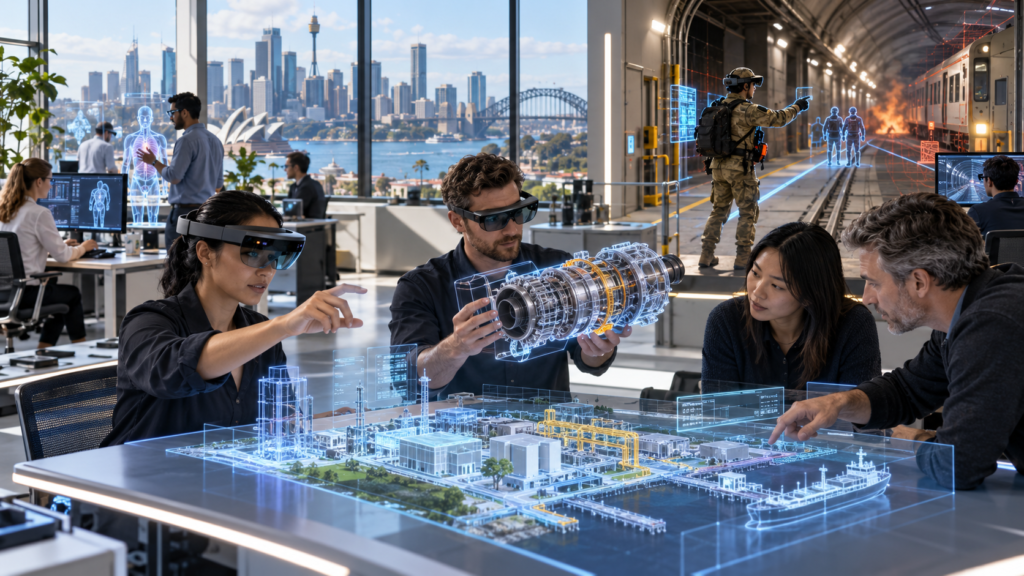
Unlike conventional virtual reality, which immerses users entirely in digital environments, mixed reality allows personnel to retain sight of their physical surroundings while overlaying virtual people, props, and effects. This distinction matters operationally. Training can occur in real facilities — schools, transit hubs, military bases, critical infrastructure, and existing shoot houses — rather than requiring purpose-built virtual replicas.
The MR-1 system combines mixed reality headsets, training weapons, and software capable of operating offline, a critical requirement for defence deployments where connectivity cannot be guaranteed. It complements Operator XR’s existing OP-2 virtual reality training product, giving the company a dual-platform offering that covers both fully immersive and physically anchored training scenarios.
xReality Group’s Strategic Position
Operator XR operates within xReality Group, an ASX-listed Australian company that has built a portfolio of simulation and training products for defence and law enforcement users. The group’s defence subsidiary focuses on mission planning and rehearsal systems that merge digital simulation with physical training tools — a positioning that aligns with growing global demand for cost-effective, site-specific military training.
Wayne Jones, Chief Executive Officer of xReality Group, framed the MR-1 launch as a multiplier effect: “The capability we built through this R&D program has immediate, broader application across Defence and Law Enforcement. This is the multiplier effect we have been working toward”.
The Broader Defence XR Landscape
Vection Technologies, another Australian XR player, has set its sights on a $22 million defence push, scaling an artificial intelligence and extended reality platform across multiple global sectors. The company’s B2B client base spans European transport operators, NATO-approved defence customers, and Australian real estate developers — evidence that Australian XR companies are not confined to a single vertical.
xReality Group’s FY26 preliminary results reinforce this trajectory, reporting total income of $20 million, a 43% increase, with an EBITDA of $3.8 million and a qualified pipeline valued at $80.4 million. The numbers suggest that defence XR is no longer a speculative bet but a revenue-generating reality.
International Distribution and Market Expansion
The MR-1’s first sale to a new US DoD customer demonstrates that the technology developed under the original subcontract has immediate commercial application beyond its initial scope. xReality Group has also begun generating contracted revenue from international distribution channels including Sweden and Japan, opening markets beyond the US and Australian base.
The outstanding milestone payments of AUD $0.85 million, once received, will complete the total contract value disclosed by the company — a reminder that even successful defence programmes involve extended payment cycles and rigorous verification processes.