Launching Sovereignty: How Australian Rocket Startups Are Rewriting the Space Map in 2026
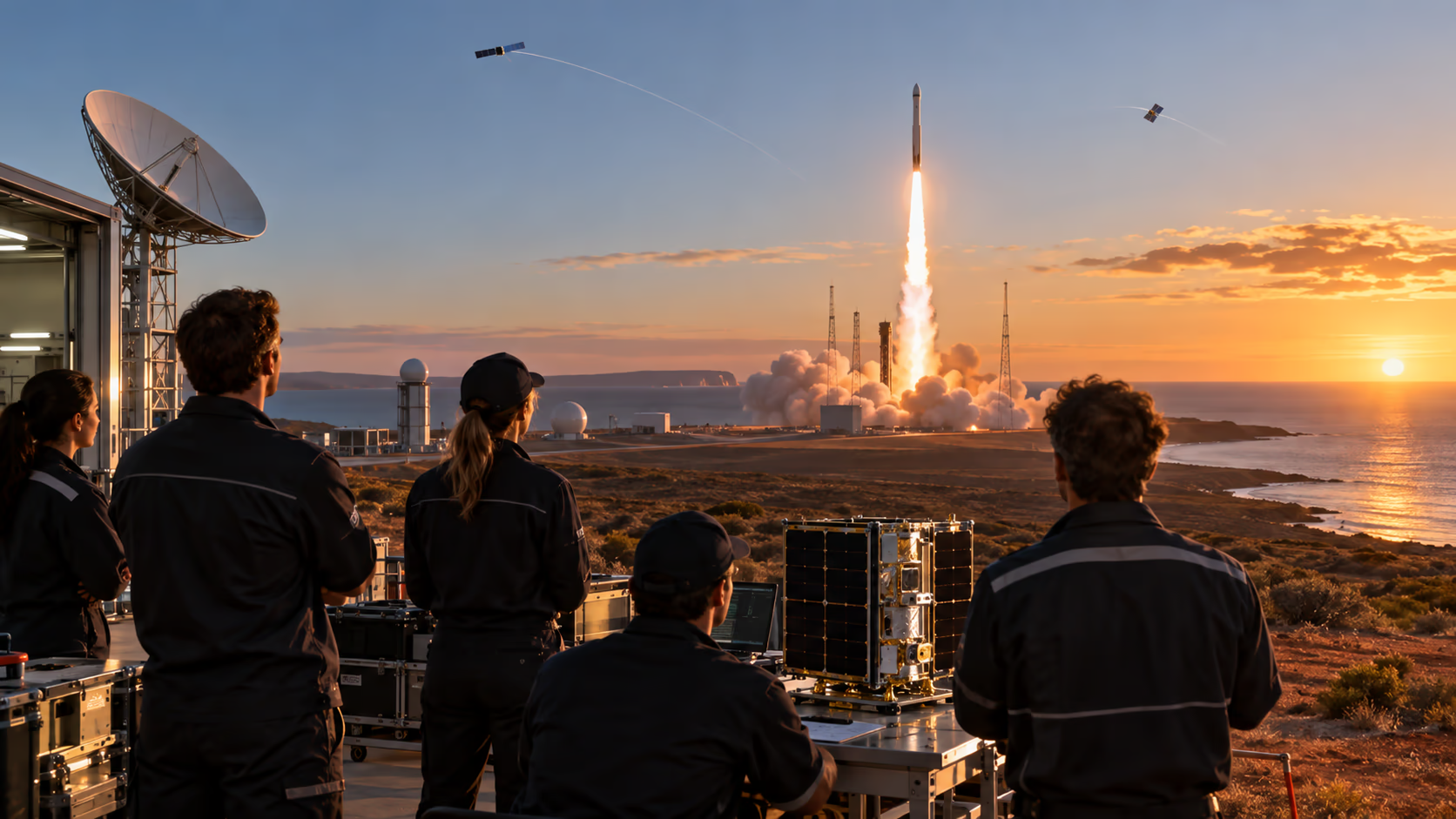
For decades, Australia’s space ambitions were limited by a simple problem: no way to launch from home. That changed in 2026. A new generation of rocket startups has turned the country into a credible launch nation, capable of sending payloads to orbit and returning them safely to Earth. The shift is not just technical. It is strategic, commercial, and deeply political.
Gilmour Space Technologies is the most prominent name in Australian launch. Its Eris orbital rocket has moved from testing to production, backed by a $217 million Series E round. The funding included $75 million from the National Reconstruction Fund Corporation and $75 million from Hostplus. The company is expanding its Bowen Spaceport in North Queensland, the only Australian facility licensed for orbital launches. Eris is designed to carry small satellites to low Earth orbit, a market that has grown rapidly as constellations for communications, Earth observation, and IoT connectivity multiply. Gilmour is also manufacturing the ElaraSat satellite bus, a 100-kilogram platform that has already demonstrated on-orbit operations. By combining launch and satellite manufacturing, the company is building a vertically integrated model that few startups can match.
Southern Launch has taken a different path. Based in South Australia, the company operates the Koonibba Test Range and the Whalers Way Orbital Launch Complex. In 2026, it closed a $25 million Series A round, with $10 million from the National Reconstruction Fund, led by Brindabella and Company. Southern Launch has facilitated the world’s first commercial spacecraft re-entry, followed by three additional re-entries, including the Varda W-6 capsule in May 2026. These missions prove that Australia can host not only launches but also return operations, a capability that is increasingly valuable for manufacturing in space, biological research, and defence payloads.
The Australian Space Agency’s official portal (https://www.australianspaceagency.gov.au/) documents the sector’s rapid expansion. Its 2026 data shows launch and re-entry as key growth areas, with multi-orbit constellations and sovereign satellite services identified as core platforms. The agency’s work is complemented by the government’s Statement on Space, released in July 2026, which calls for an enduring space sector built on domestic capability. For launch startups, this means more than grants. It means a clear demand signal from government and defence customers.
The commercial logic is compelling. Australia’s geography offers advantages for launch: vast, sparsely populated areas, access to polar and equatorial orbits, and established ranges with decades of experience. The Koonibba Test Range, for example, is owned and operated in partnership with the Koonibba Community Aboriginal Corporation, making it one of the few launch sites in the world with genuine Indigenous co-management. That model is attracting international customers who value both technical reliability and social licence.
Competition is intensifying. Gilmour Space and Southern Launch are not the only players. Smaller firms are developing suborbital rockets, hypersonic test beds, and reusable technologies. The Venture Catalyst Space program in Adelaide selected eight startups for its 2026 cohort, several of which are working on propulsion, materials, and launch-related software. Since 2018, the program has supported 54 startups, helping them raise up to $135 million. The pipeline is deepening, even if the headline funding rounds go to the most mature companies.
Challenges remain. Launch is capital-intensive, regulated, and unforgiving of failure. Insurance, range safety, and export controls add complexity. International competitors, particularly in the United States, China, and New Zealand, are moving quickly. But Australia’s launch startups have something their predecessors lacked: government backing, private capital, and a proven ability to execute. In 2026, the question is no longer whether Australia can launch. It is how often, how reliably, and how soon the nation can become a routine launch destination for the world.