Carbon Farming and Blockchain Traceability: How Australian Agribusiness Is Feeding Asia and Cutting Emissions
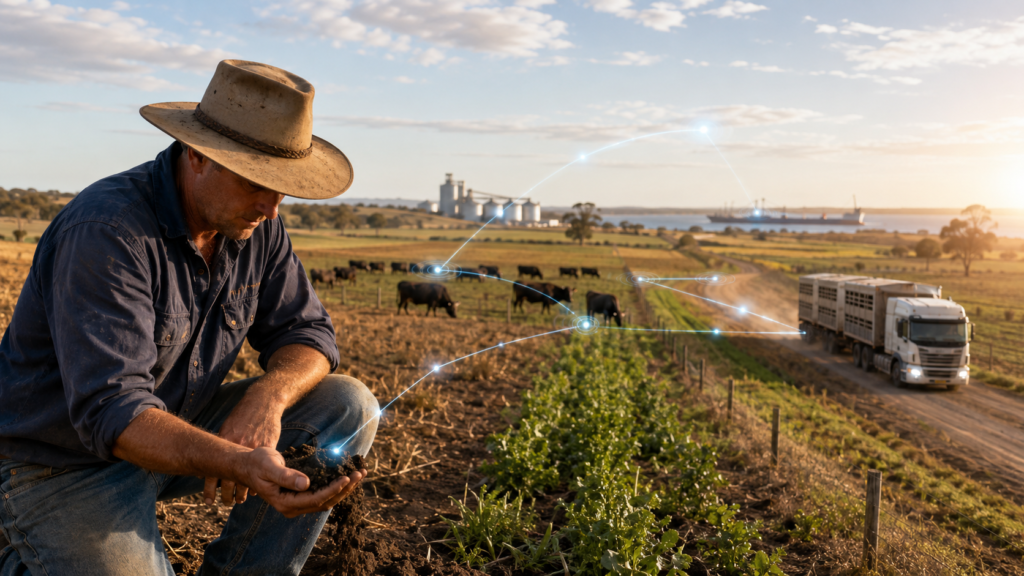
In a sunburnt paddock near Dubbo, a soil sample is no longer just dirt—it is a potential carbon credit. Australian agribusiness companies are converting regenerative farming into tradeable carbon units while using blockchain to prove every step from farm gate to export port.
Carbon Credits Turn Soil into a Revenue Stream
Soil carbon projects reward farmers for increasing organic matter, planting cover crops and managing grazing rotations. Each tonne of carbon sequestered can generate an Australian Carbon Credit Unit (ACCU), which is sold to companies needing to offset emissions. For a typical mixed farm, soil carbon income can add A$50,000 to A$120,000 per year, depending on rainfall and soil type.
Soil Carbon Projects Surge Under the 2026 Safeguard Mechanism
The federal Safeguard Mechanism has tightened emission limits on large industrial facilities, pushing demand for land-sector offsets. According to the Clean Energy Regulator’s updated project data released in July 2026, available at Clean Energy Regulator soil carbon page, more than 1,200 soil carbon projects have been registered nationally, with ACCU issuance surpassing 2.8 million tonnes since 2020. That growth signals a structural shift in how farmers view soil health.
Blockchain Traceability Builds Import Trust
Asia’s premium supermarkets and food service buyers increasingly demand proof of sustainability, welfare and low-carbon production. Blockchain platforms such as AgriDigital, BeefLedger and T-Provenance allow Australian exporters to create a tamper-proof digital record from paddock to plate. A QR code on a Wagyu steak, for instance, can show the animal’s birth property, feed regime, transport history and carbon footprint.
From Farm Gate to Port: Scanning the Food Chain
A New South Wales beef producer using blockchain records each mob movement, veterinary treatment and batch of feed. When the chilled product arrives in Tokyo or Singapore, an importer scans the code and verifies that the meat matches the claimed grass-fed, antibiotic-free specifications. This reduces disputes, speeds up customs clearance and attracts a price premium of up to 15 percent in some markets.
Asia-Pacific Food Resilience Hinges on Australian Reliability
Climate-driven crop failures in Asia have increased demand for dependable Australian grain, meat and dairy. Australia already supplies a significant share of beef and wheat to Japan, South Korea and Indonesia. By pairing carbon farming with blockchain traceability, agribusiness companies are offering not just a commodity but a verified low-risk supply chain. That makes Australia a preferred supplier for governments and retailers worried about food security.
As carbon markets mature and digital traceability becomes standard, Australian agribusiness is turning environmental performance into a competitive advantage across the Asia-Pacific.