Quantum Startups Are Becoming Australia’s Strategic Industry Backbone
From Physics Labs to National Infrastructure
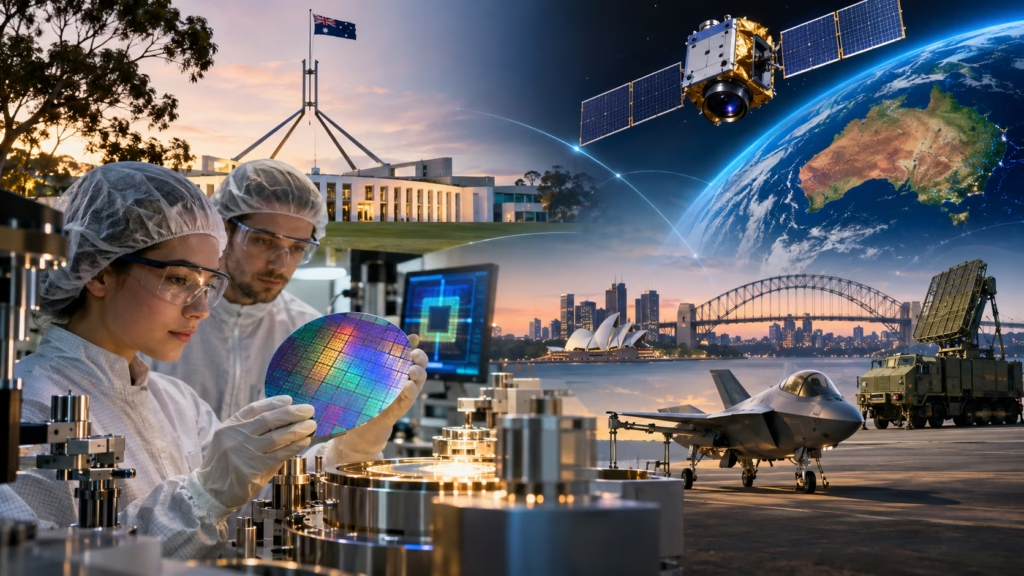
Quantum technology in Australia has crossed a threshold in 2026. It is no longer framed primarily as a research excellence story. It is increasingly described as a strategic industry input—a technology layer that underpins energy systems, defence communications, biosecurity and advanced manufacturing. The Critical Technologies Challenge Program (CTCP), a A$36 million grant initiative under the National Quantum Strategy, is funding consortia that pair quantum hardware with end-user problems of national significance.
That design is deliberate. Instead of funding technology for its own sake, the program requires startups to demonstrate a market-led challenge and a pathway to adoption.
Silicon Quantum Computing and the Energy-AI Convergence
One of the most strategically pointed CTCP projects belongs to Silicon Quantum Computing. The company received A$3.6 million to develop a platform that combines quantum computing with AI to improve energy forecasting and support renewable energy integration. The project connects quantum processors with the AI prediction models used by energy management giant Schneider Electric.
This is a significant shift in how quantum startups position themselves. The value proposition is not a general-purpose quantum computer decades away; it is a quantum-enhanced AI accelerator that addresses a live operational problem in the electricity grid. For strategic industries, that framing is more investable, more procurable and more politically durable.
QuantX Labs and the Timing Layer of Strategic Infrastructure
QuantX Labs, an Adelaide-based quantum technology company, illustrates the infrastructure dimension. In June 2026, the company secured US$5 million in seed funding from Serendipity Capital to scale its optical atomic clock technology, with projections of more than 50 jobs and up to A$120 million in new revenue over four years.
QuantX’s precision timing subsystem was already in orbit aboard a SpaceX Transporter-16 mission by April 2026. The strategic logic is straightforward: modern defence systems, telecommunications networks and critical infrastructure all depend on precise timing, and that dependency grows as systems become more complex. GPS-denied environments—whether through jamming, spoofing or physical denial—make sovereign timing capability a national security input, not a niche instrument.
Biosecurity, First Nations Health and the Broader Quantum Application Layer
The CTCP portfolio also shows how quantum startups are being pulled into areas that rarely appear in deep tech narratives. FeBI Technologies received A$2.2 million to develop accurate testing and diagnosis of iron deficiency in First Nations peoples. Avicena Systems received A$2 million for a quantum biosensor aimed at more efficient border inspections. iQ Sense received A$1.2 million for real-time livestock health monitoring.
These are not side projects. They are evidence that quantum sensing and quantum-enabled diagnostics are becoming applicable across health, agriculture and biosecurity—sectors that sit squarely within Australia’s national strategic interests. The commercialisation pathway is still early-stage, but the direction is clear: quantum is being embedded into the operational fabric of strategic industries rather than confined to a future general-purpose computing horizon.
The Sovereign Manufacturing Question
The remaining constraint is manufacturing. Australia’s quantum strength has historically been strongest in research and IP, weaker in volume production. The NRFC’s expanded investment in SQC explicitly ties quantum computing to onshore quantum chip manufacturing capability, describing SQC as one of Australia’s only semiconductor manufacturing companies. That linkage—quantum IP plus atomic-scale manufacturing—is the bridge between a research ecosystem and a strategic industry.